Buried, forgotten, invisible for over a century. A cemetery in a farmer’s field with numbered graves, so forgotten that it was not even included in available historical documentation until very recently.
Such has been the lot of the 55 to 60 children who attended the Battleford Industrial School and were buried there. There are more graves than that but these likely include several teachers who served at the school as well as people from the surrounding communities and Indian reserves; the graveyard was for many years a place for free burials.
Now an entry on Wikipedia brings the story of the Battleford Industrial School (BIS) to light, making the children known and visible.
“Battleford Industrial School (BIS) was a Canadian Indian residential school for First Nations children in Battleford, Northwest Territories (now Saskatchewan) operating from 1883 to 1914. It was the first residential school operated by the Government of Canada with the aim of assimilating Indigenous people into the society of the settlers.
“It operated out of the former Government House building, which was the seat of the NWT government until 1883. Then, in 1914, after the school closed, it became the property of the Seventh Day Adventist Church (1914 – 1932) and then the RC religious order of the Missionary Oblates. The building burnt down in 2003.”
The Truth and Reconciliation Commission of Canada noted in its final report: “The opening of the Battleford Industrial School (BIS) in 1883 marked a turning point in Canada’s direct involvement in residential schooling for Aboriginal people.
Prior to that, the federal government had provided only small grants to boarding schools in Ontario and the Northwest that had been founded and operated by Christian missionary organizations. By 1884, there were three industrial schools in operation: Battleford, High River, and Qu’Appelle.”
The school was opened as an “industrial” school where children lived and attended school for a few hours per day but also worked in various occupational roles within the school such as the dairy, bakery, print shop, laundry, carpentry, shoe making, and farming. The male students were often sent out as cheap labour for farmers harvesting produce or constructing buildings.
They were also employed to construct buildings in the community. Girls would be sent out for periods of time “on service” as cheap labour for families in the region where they would work as nannies or help in family homes. (Source: https://en.wikipedia.org/wiki/Battleford_Industrial_School).
The operation of the BIS was entrusted to the Anglican Church of Canada with an Anglican minister appointed by the federal government as the principal. Given the historical time-period, this would have been under the auspices of the Anglican Diocese of Saskatchewan though, since 1936, the location has been within the borders of the Anglican Diocese of Saskatoon.
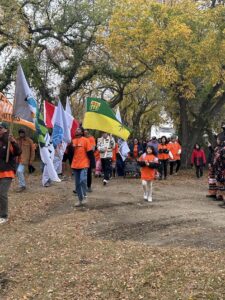
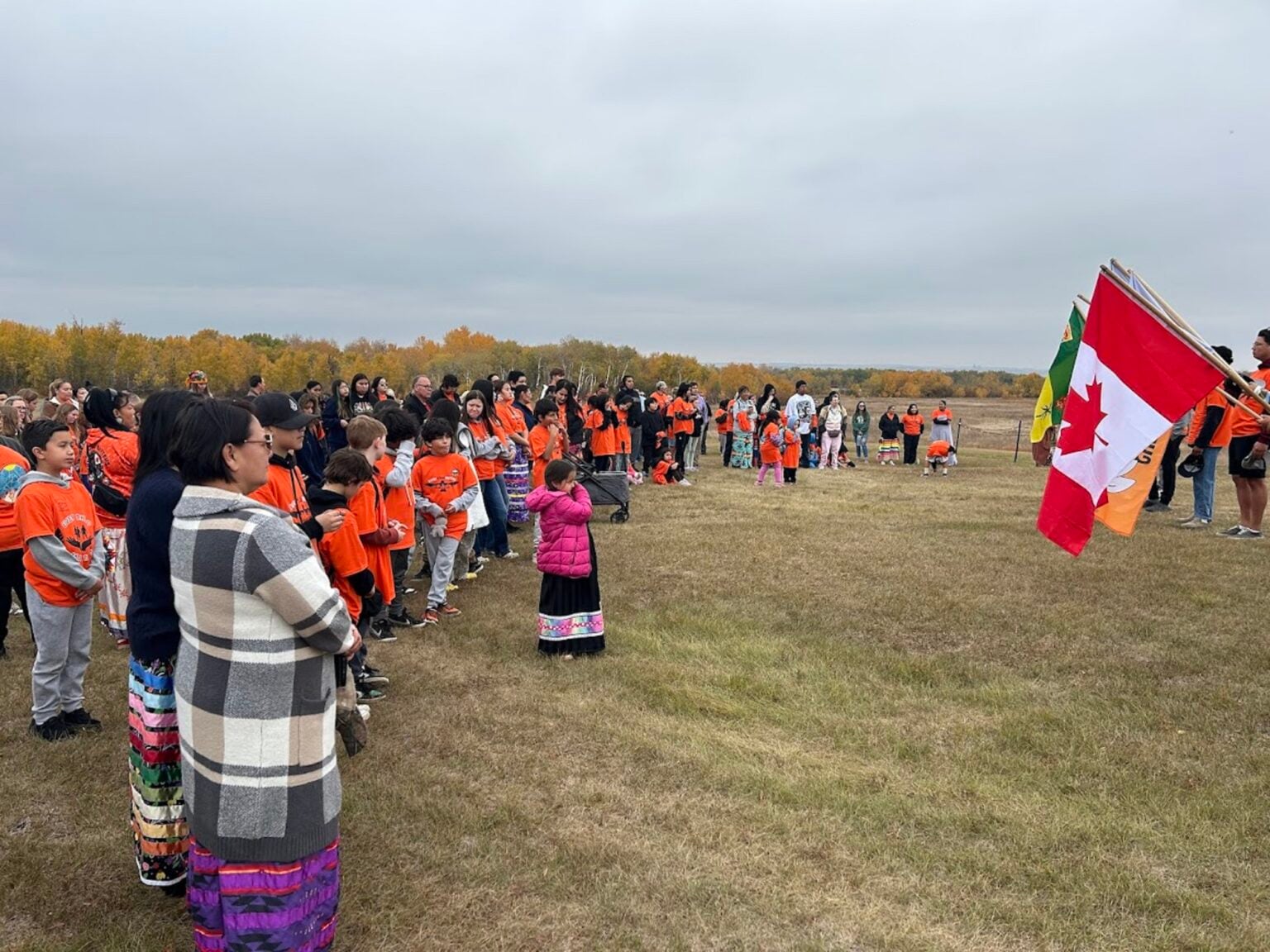
I felt the Anglican shadow of history hanging over me when, on Orange Shirt/Reconciliation Day in September 2025, I found myself in a sea of orange up on that same hill where the school once stood.
The heavy, painful shadow slowly began to lift as a powwow, ceremony, speakers and drummers called out to the children to come back to life in our collective memories, in order to bestow honour and recognition and respect, none of which they received in their lifetime nor in their death.
The ceremonial walk/procession to the cemetery, led by the drummers in the pickup truck, followed by the flag-bearers and elders, felt like an opportunity for atonement and reparation, for healing and reconciliation. Standing at the gates of the cemetery, listening to the ceremonial prayers and blessings, it was as if I heard the children whispering: we hear you, and we are rising.
In 2021 the property was bought by the Mosquito Grizzly Bear’s Head Lean Man First Nation from the RC religious order the Missionary Oblates, the same religious order that had operated numerous residential schools throughout Western Canada.
The Oblates ran their own seminary and formation centre there from 1932 to 1972, followed by a home for retired priests and brothers. The property, which has now been renamed “The Ridge,” now operates a wellness centre, serves as a hub for Indigenous economic development, and hosts numerous Indigenous events. An interpretive centre and art gallery are under construction.
Oblate priests and brothers continue to be buried in their own cemetery on that same hill, with the First Nations people as their cemetery custodians. History has come full circle.