
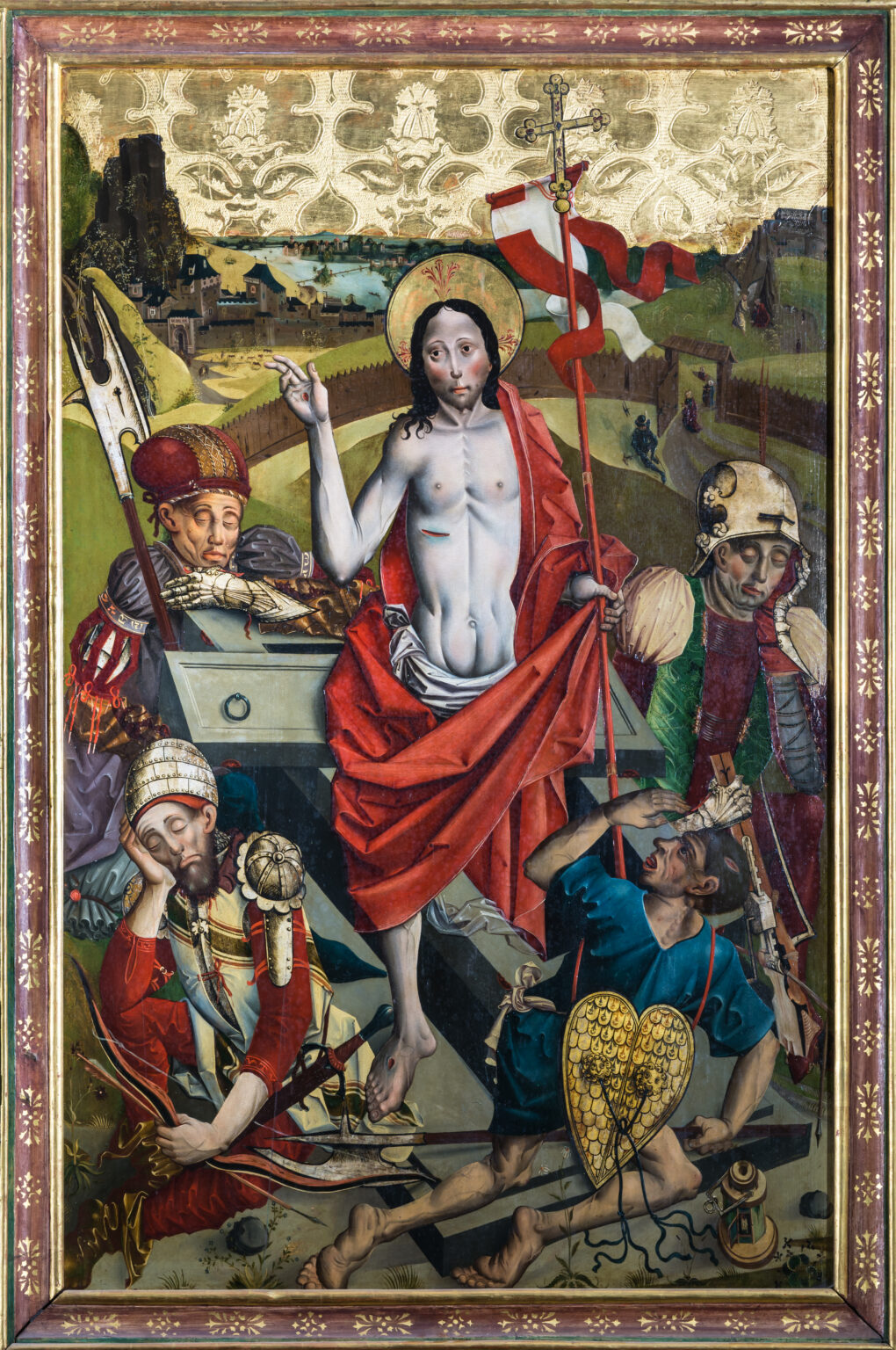
For many of us, the concept of Jesus’ descent into hell catches us off-guard; for our modern ears, “hell” brings to mind imagery of fiery judgement and fearful punishment, a setting of pervasive burning and perpetual agony. To consider our Lord and Saviour (let alone anyone) being subject to that level of suffering seems incongruous with our understanding of a loving and merciful God.
It becomes important, then, to consider how much the concept of hell has changed in the millennia since the creeds were written, and what the context was for including this within them. In biblical times, “hell” referred to the Hebrew Sheol or Greek Hades (an underworld place of stillness and darkness that is death), or to Gehenna, the Valley of Hinnom, which was a literal garbage dump/incinerator outside of Jerusalem.
Why would the early church, then, consider that Jesus had gone to this place of inactivity and vital absence? And why did it matter enough to be placed within the creeds? The creeds have been written for several purposes: mainly to articulate our faith as what we do believe, but also to refute those things we do NOT believe.
The Greek word used in the creeds offers another perspective of “hell”: they used katōtata, which translates as a lower area, or beneath the earth, or underworld. Thus, the creeds intended to highlight that Jesus, being fully human, had been fully dead.
This was important, as there was a dispute in the early church about the authenticity of the Resurrection. Docetism was a second-century heresy that suggested Jesus was more appearance or semblance than reality; as an apparition, true death could not happen.
The Council of Nicaea (from whence the Nicene Creed came to be) was clear in its rejection of this concept. Over the centuries, other theories have also arisen (and been rejected), such as suspended animation or temporary unconsciousness, or that Jesus was not fully dead when removed from the cross, thus did not experience Resurrection, but rather that He simply recovered in His three days in the tomb.
Thus, the creeds are clear that our faith believes in the full human death of Jesus, and the subsequent miraculous Resurrection of Christ. In making the declaration that Jesus went to the place of the dead, we affirm the power of God to overcome the grave.
God’s promise of Resurrection for us all brings comfort that our earthly death is not the end, and that we will be reunited with those we love but see no more.
This understanding actually aligns well with where we see the word “hell” in the creeds. In the Book of Common Prayer (1962) the line “descended into hell” is present in the Apostles’ Creed (such as at Morning and Evening Prayer, pages 10 and 22) and in the Athanasian Creed (page 697).
The service of Holy Communion, however, uses the Nicene Creed, which references that Jesus was “dead and buried” (page 71). In the Book of Alternative Services (1985), the Apostles’ Creed states that Jesus “descended to the dead” (page 190) and the Nicene that He “suffered death and was buried” (page 189). The emphasis remains on affirming death and thus Resurrection.
Further, I think it is beneficial for us to include our affirmation of faith as a regular component of our worship. The creedal statements allow and require us to deeply consider the teachings we have received in the sermon and in the prayers, ensuring that the theology aligns with our core beliefs.
Thus, we are not passively accepting whatever might be told to us, but actively participating in the continuing teachings of the church faithfully. When we declare “I/We believe,” we are joining with the faithful through the ages in celebrating the foundations of our faith.
The Rev. Dr. Laura Marie Piotrowicz is the incumbent of St. John’s Anglican Cathedral in Saskatoon.