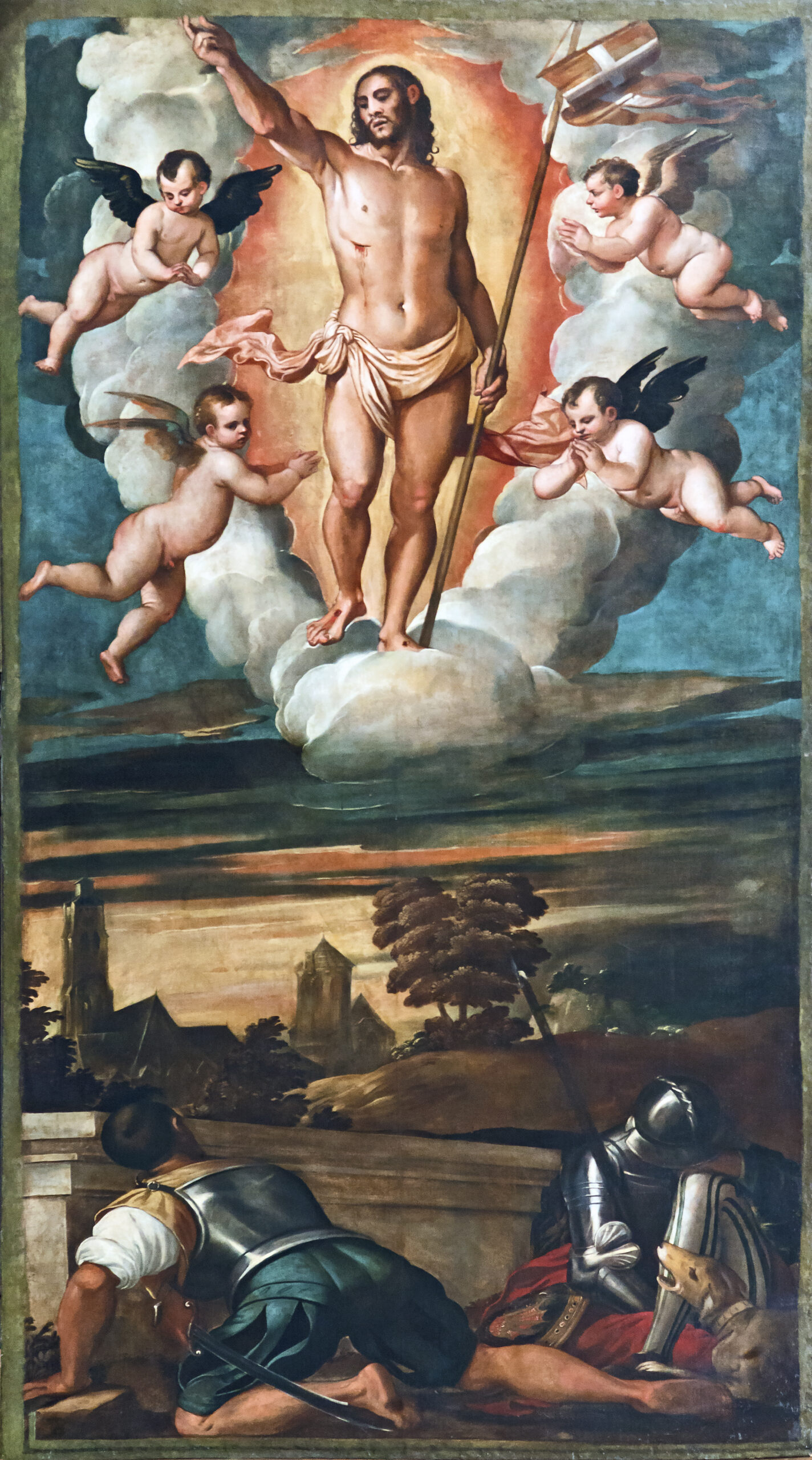
In John’s version of the story that we read on Easter Sunday, it is Mary Magdalene on her own. In other tellings, there is some combination of one or two other Marys, a Salome, a Joanna, etc.
But in each case, the basic idea is the same: In the wake of Jesus’ death, when the majority of the proto church is completely shattered, disoriented, and afraid, it falls to a small group of courageous women to take a step out in faith.
In the tradition of the Eastern churches, this group is often referred to as the Holy Myrrhbearers. On a literal level, this is a title given to describe the function they perform — carrying spices to the tomb to anoint the Lord’s body. On its own, this also is already an honorable task, remaining faithful to the spiritual and religious customs of their people even when doing so comes with some personal risk. But, looking deeper, it seems to me there is an even greater layer of meaning contained in their example, and one with some particular ecclesial relevance for the disciples of Jesus today.
To be a Myrrhbearer, in an expansive and contemporary sense, is to be someone who does not shy away from acknowledging the realities of death and decay in the Body of Christ, but faces them with a special degree of supernatural grace and persistent hope.
They take the risk to open the doors in the midst of considerable upheaval and uncertainty about what is coming next, to carry on in their ways of faith, and to place balm on the Church’s seemingly fatal wounds. They do this somehow believing that the story is not quite over yet. As they do, they also discover a Jesus who is very much alive and who takes them by surprise anew.
I believe that the icon of the Myrrhbearing women is an especially apt one for picturing the vocation of membership and leadership in the Church in this time.
Although the reality of uncertainty, fear, apparent failure, and maybe even death to the prevailing institutional expressions of the Jesus Way we’ve been used to are all around us, our call is to name it openly, to do the hard things that need to be done, to grieve what needs to be let go of and grieved, and yet to faithfully persevere in living the way of our spiritual forbears with a belief that this present moment may not necessarily be the very last word. And in so doing, we too will find that Jesus isn’t gone at all, but is merely somewhere we had not unexpected.
We will discover that a new kind of life can rise up from what seems like decline into the grave.
The Rev. Scott Sharman is the Anglican Church of Canada’s National Animator for Ecumenical and Interfaith Affairs.