
Editor’s note: This is an update of an article that appeared in the Saskatchewan Anglican in December 2011 and 2018.
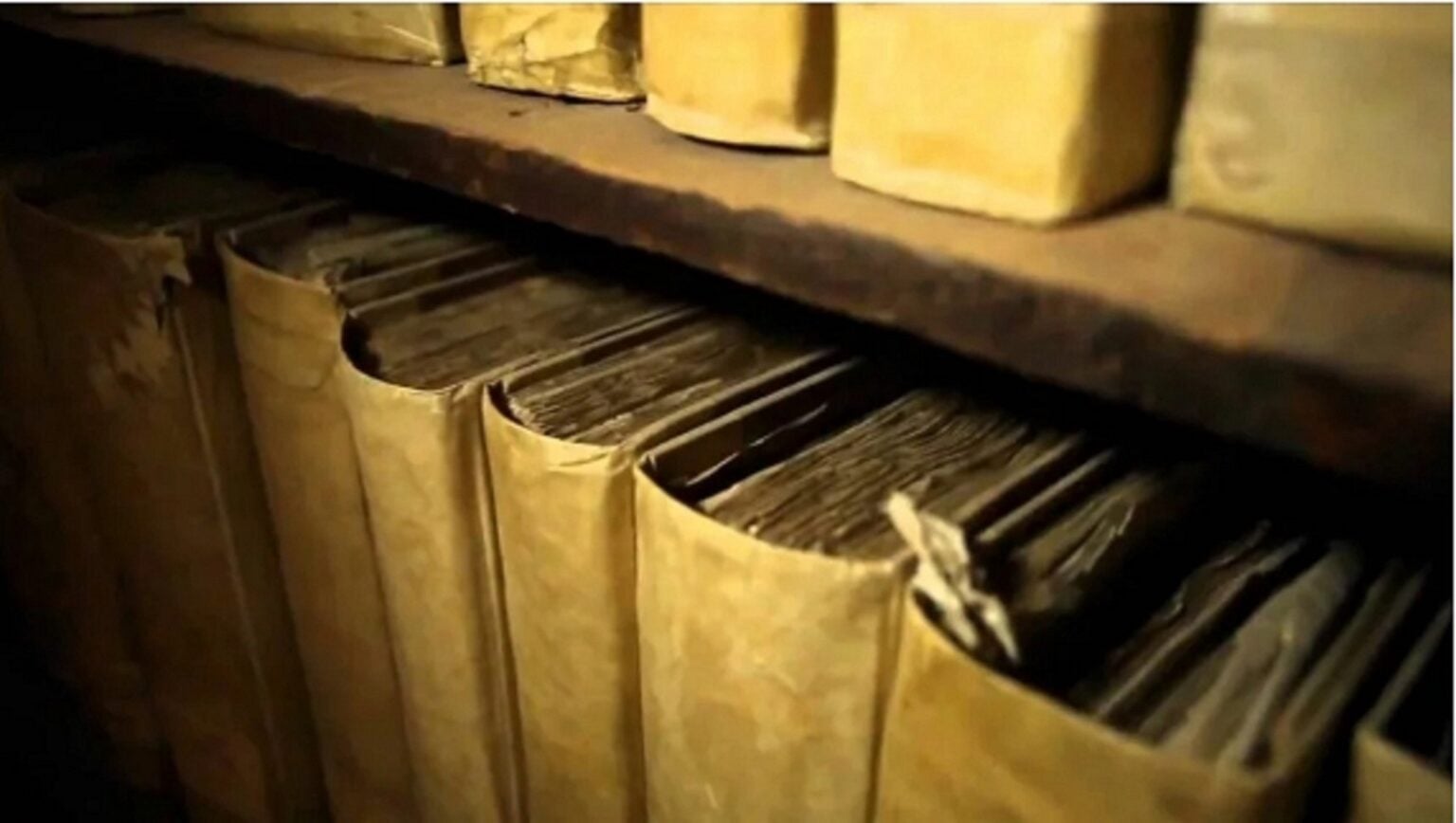
SASKATOON — Who are we, how did we get this way, and where did we come from? These are all questions that, at least from a historic and spiritual point of view, can be addressed in part by the archive of records and materials from our diocese, its parish churches, individuals and parish organizations preserved in the diocesan archives.
The archived materials in the diocesan archives represent a treasure trove of information from our past for us to use now and are also a gift from us to the future.
History and archives can be fun! Here are a few examples of the oddities of history in our diocese that you may not know:
- What parish’s name was changed after the Second World War in exchange for cash provided by a parish in London, England, which was bombed during the Blitz in the war?
- What parish church contains a Great Window of stained glass dating from before the 1642 to 1651 English Civil War?
- How is the College of Emmanuel and St. Chad Anglican Theological College, located in Saskatoon, responsible for the University of Saskatchewan having the name it has?
(Answers at the end of the article)
Storing the archives
The archives of the Diocese of Saskatoon are the property of the Synod of the diocese and are now stored in two locations in Saskatoon: the old synod office at the former St. Mark’s Parish property and the new All Saints’ Diocesan Centre in the former All Saints’ Parish building.
A significant group of the archived holdings also remains in the Provincial Archives Board offices in Regina, awaiting the arrangement of their move to Saskatoon in the coming months.
All these files, for the first time in three decades, after living in a variety of separate locations (often in locations difficult to access), are in the process of being centralized in a new archives room in the new Diocesan Centre. This centralization is expected to be completed this summer.
Following this centralization, there will be an effort to sort through the entire archive holdings to ensure that all files are catalogued in one uniform systematic way and to confirm that nothing is missing. The services of the archives to those seeking information from the archive, during this time of consolidation, will not be interrupted, but there may be significant time delays.
Access to the records in the archives is provided through the diocesan archivist, who manages the daily sorting and cataloguing of new materials submitted, and searches for, locating, materials already catalogued in the system.
Materials suitable for archiving
What could our archives contain? Sadly, not everything that should be included in the archives is there. Many records have been lost, destroyed or otherwise have disappeared and/or have never made it to the door of the archives.
Normally, all records and other materials related to the running of the business of a parish, diocesan organizations and Synod Office should be archived after a suitable period of time has elapsed, such that these records are no longer necessary for the running of a parish, the organization or the Synod Office.
The Synod Office, individuals, parish organizations and parishes of the diocese may submit any materials they consider worthy of preservation to the archivist, who will determine if the material (in whole or in part) is suitable for inclusion in the archives. If found suitable, the archivist will arrange and catalogue these new materials within the archives.
Materials suitable for archiving include, but are not limited to, the minutes of parish vestry and all parish and synod committees and organizations; Synod Office and diocesan council meetings; the annual financial statements from all parish vestries and parish committees and organizations (or other financial records if annual financial statements are not available), and the minutes of synod committees and diocesan council and deanery meetings; reports of annual parish meetings and diocesan synods; records of the diocesan ACW and Mothers’ Union; cemetery records; land title records; architectural plans and designs; and all registers of services, baptisms, burials, confirmations and marriages.
In addition to these items, more personnel materials, photographic materials, books, ceremonial objects, memorial plaques, etc., of a historic nature can also be included.
Protection of historic records is especially important at the time of the disestablishment or closure of a parish. In such a case, the archivist, in consultation with the diocesan registrar, the diocesan administrator and the bishop, will advise those responsible for handling the closure of the affected parish of the need for the transfer of these materials and may be involved in doing this.
Also, in order to preserve and make access easier, parishes should ensure all registers of services, baptisms, confirmations, burials and marriages are given to Synod Archives once they have been completed or have been in use for an extended period of time.
Viewing the materials
Registers of baptism, burial, confirmation and marriage and personnel files are legal documents and contain information considered to be personal and confidential. If the records are more than 90 years old, the registers may be viewed in the presence of the archivist; if less than 90 years old, access to the registers is restricted, and the registers cannot be viewed.
But, details of the information contained may be requested by family members of individuals or the individuals themselves named in the record sought. In rare cases, records may also be requested by a person authorized by the family or individual named in writing.
Please note that access to the archives does not constitute permission to publish all or portions of the material. Permission to quote unpublished material or to reproduce any material obtained from the archives must be obtained in writing.
The archived records are also catalogued and searchable in a computerized database by subject, but not by individual name. In the case of the registers of baptism, marriage, burial and confirmation, all searches of the registers must be done manually in the order of parish, date and then name, as there are currently no keyword, name or subject indexes or databases to assist in these searches.
On request, the archives can provide either the information on the data recorded, hard copies of the records in the registers, or it can also issue new, signed and sealed certificates of baptism, confirmation, marriage and burial. There is a small charge for each of these services to offset office costs.
So, where does all this leave us? The diocesan archives represent an important historical resource and reference for the safekeeping of our history. The diocesan archivist is here to help you sort through, locate and retrieve historic material while at the same time safeguarding and preserving these materials for future use.
If you have materials of a historic nature relating to our Church and the Diocese of Saskatoon that you would like to have considered for preservation within the diocesan archives, please contact the diocesan archivist, Rev. Peter Coolen, at 306-244-5651 or 306-244-0935 or at [email protected].
When submitting materials, it is better not to pre-sort them, as this may remove important information and context. Attaching notes to individual items explaining the importance or background for particular items is, however, often very useful.
See you in the future!
Answers: 1) Holy Trinity, Maidstone was renamed St. Andrew’s by the Wardrobe, Maidstone in 1942; 2) The tryptic window of Peter, Paul and Christ at All Saints’, Watrous, 3) Emmanuel College was founded at Prince Albert in 1879. An Act of the Dominion Parliament established and incorporated the College as “The University of Saskatchewan” in 1883. When the provincial government established its own university in Saskatoon in 1909, Emmanuel College moved to that city and, while retaining its university status, relinquished its charter title to the new university, taking as its new name, The University of Emmanuel College. St. Chad’s College was established in Regina in 1907, where it continued its work until 1964, when it amalgamated with Emmanuel College. Together, they formed the College of Emmanuel & St. Chad, which continues as an affiliate college of the present University of Saskatchewan.