Editor’s note: The following article comes from the book, “From Tent to Cathedral: A History of St. Paul’s Cathedral, Regina,” by diocesan archivist Trevor Powell. Chapter 6 goes into detail about how the First World War affected the Anglican Church in Saskatchewan and around the world.
The outbreak of war in August of 1914 weakened the position of the Church of England on the prairies at a time when its greatest missionary offensive to date was beginning to show results.
While all religious denominations would feel the effect of the European conflict sooner or later, the Anglican cause was hurt immediately. This was largely due to the heavy reliance on manpower from the Mother Church.
During the first year of the war, six clergy of the Diocese responded to the patriotic call and returned home to join the military ranks as chaplains.
Neither the Reverend Canon Hill nor his assistant, the Reverend Walter Western, approached the Bishop for permission to serve their God and empire overseas, as they believed their duty was to minister to the people on the home front.
However, no less than 150 members of St. Paul’s congregation did volunteer their services and, by January 1915, had left for the front.
Officers accompanying their units overseas with the first and second contingents included Lieutenant-Colonel J.F.L. Embury, Lieutenant Allen Child, Mayor J.L.R. Parsons, Lieutenant F.B. Bagshaw, Captain F. Arnold, Lieutenant M. McCausland, Captain Harry Morell and Captain J.A. Cullum.
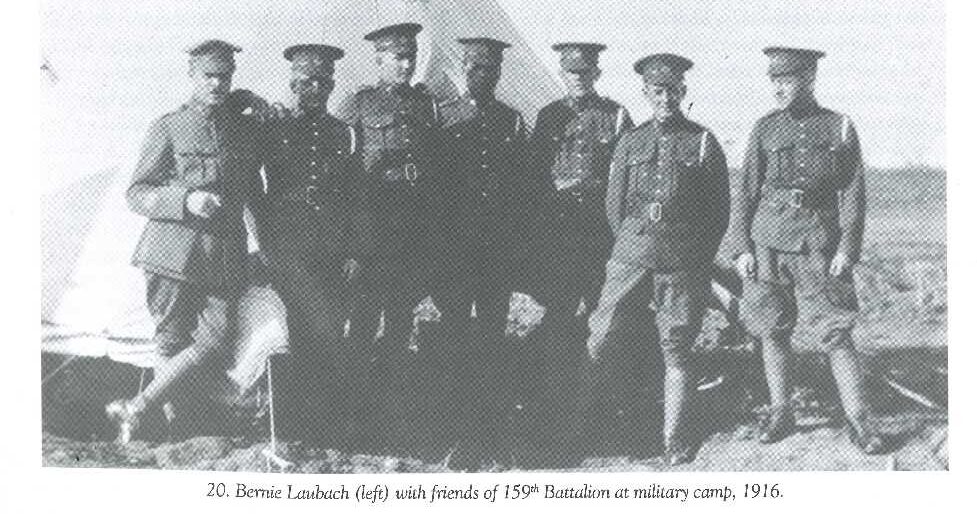
Later that year the organist, Mr. A.C. Ballantyne, requested a leave of absence for active service. Several months later, the choirmaster, Franklin Laubach, at age 59, followed suit and joined the 68th Battalion as bandmaster. His son, Bernie, took over the duties of organist and choirmaster.
Reduced church activities
Enlistment seriously curtailed the work of men’s organizations within the parish. Of the Brotherhood of St. Andrew, only two out of 15 members remained. Likewise, the Young Men’s Bible Class, formerly 40 strong, was reduced to 25 by early 1915, and to 15 the following year.
Asked by a newspaper correspondent to explain the sudden loss, Canon Hill responded by saying, “… that one of the reasons why his congregation had suffered to such an extent, in comparison with other congregations of the city, was on account of the fact that a large percentage of those enlisting were English born.”
As Canada intensified its mobilization efforts, more and more parishioners joined the military ranks so that, by April 1916, a total of 209 men and women were in uniform.
Despite this loss, parish life carried on. The prolonged absence of men meant that women took over some of their responsibilities.
To bolster the depleted ranks of sidesmen, the Reverend Mr. Western suggested to Vestry that women of the congregation assist “… to make all lady strangers and visitors at services welcome.”
That body decided to approach the Women’s Auxiliary about forming a Greeting Committee for Sunday duty. Women were also given a greater voice in the running of parochial affairs. As a result of a resolution at Diocesan Synod in March 1916, they were granted the right to vote at annual and vestry meetings.
Financially, the parish of St. Paul fared reasonably well. Income dropped slightly during the first two years of war; this decline being attributed to competition from the Canadian Patriotic Fund, the Red Cross and other appeals.
Anxious to reverse this trend, Vestry looked to other, more methodical ways of raising funds. Finally, it was decided that a block-by-block canvass should be undertaken by the parish in February 1917.
This was the first time this form of stewardship had been used and it proved so successful that similar arrangements were made the following year to clear a few remaining debts.
Supporting social issues
During the war years, clergy and laity began to show a greater interest in the social problems of the day. On June 18, 1916, a small group of women from various Regina parishes, concerned about the quality of home life during wartime and its influence on young people, gathered at St. Peter’s Church to hear Dominion President of the Mother’s Union talk about the objectives of that fellowship.
She told them that the goal of the organization was “to deepen the sense of responsibility in mothers and in all those who have the right upbringing and the implanting of the highest ideals to boys and girls at heart.”
While those present expressed interest in the role of the Mother’s Union, no attempt was made to form a Regina branch.
In November of the same year, all members of the Vestry attended the Social Service Congress held in Regina. At a session on “The Family: Its Perils and Safeguards,” chaired by Premier W.M. Martin, the Reverend Walter Western, Curate of St. Paul’s, gave a paper entitled “Religious training in the Home.” With the exception of a small Evangelical element, Anglicans had rarely participated in public debates on moral and social issues.
Ban the bottle
Prohibition was a case in point. Delegates to Diocesan Synod in June 1914 had rejected a call for support of the “Banish the Bar” campaign.
The Church of England had always been interested in securing temperance as very child, before being confirmed, acknowledged its duty as a member of the Christian Church to keep its body in soberness, temperance and chastity. But that was as far as the majority of delegates were prepare to go.
Two years later, the total commitment demanded by a nation at war had caused many Anglicans to change their minds. By then, however, abolition of the bar was not enough; total prohibition was demanded.
The Reverend Messrs. Hill, Earp and Simpson (St. Mary’s) all claimed to be converts to the prohibition movement, although they were not as strong in their advocacy as were other Protestant clergy in Regina.
War’s effects
For those at home, the war at first seemed so far away. With each passing day, however, the mounting toll of casualties brought this “war to end war” closer to home. The number of men from St. Paul’s who were killed or wounded rose steadily.
Memorial services were held and, on occasion, a plaque was mounted in the church by families. In 1917, the idea of erecting a memorial to the fallen was raised but with no end to the conflict in sight, the matter was tabled.
That same year, the parish almost became a visible part of the war effort on the home front. Vestry was asked to consider the proposition of leasing the parish hall for one year to the military as a depot.
The matter was subsequently dropped, only to be followed by a request from the Executive Committee of the Diocese that part of the hall be used to accommodate a proposed Diocesan Girls’ School.
The Committee had decided to accept a grant of $3,000 from England for educational purposes and an offer from the Sisters of St. John the Divine to take charge of the school. until a suitable building for a boarding school could be located, temporary quarters to run a day school were needed.
Eventually, the Vestry decided to lease the upper portion of the hall to the Synod but, in the meantime, other arrangements were made by the Diocesan authorities.
Military help
Just before hostilities ceased, the Vestry was approached by the Canadian military once again. Vestryman R.J. Westgate reported that he had been asked about the availably of the parish hall as a hospital.
That body expressed a willingness to co-operate on the condition that the building would not be used to treat infectious diseases. This stipulation arose largely as a result of the influenza epidemic which ravaged the population of Regina during October and November 1918.
The military authorities acceded to this request before taking over the premises, which they occupied until Colonel J.A. Cross recommended to Ottawa that possession be given up on June 15, 1919.
With the end of fighting in Europe, Canadians longed to return to the way of life they had known before the war. However, war had changed society and its institutions considerably.
The Church had undergone change, too. Those returning to St. Paul’s noticed a more systematic way of conducting parochial affairs, the expanded role of women and the greater interest in social concerns and co-operative ventures with other churches.
Acceptable or not, both the returning soldiers and those at home shared the desire to make the world and society a better place to live. There was no turning back the clock.