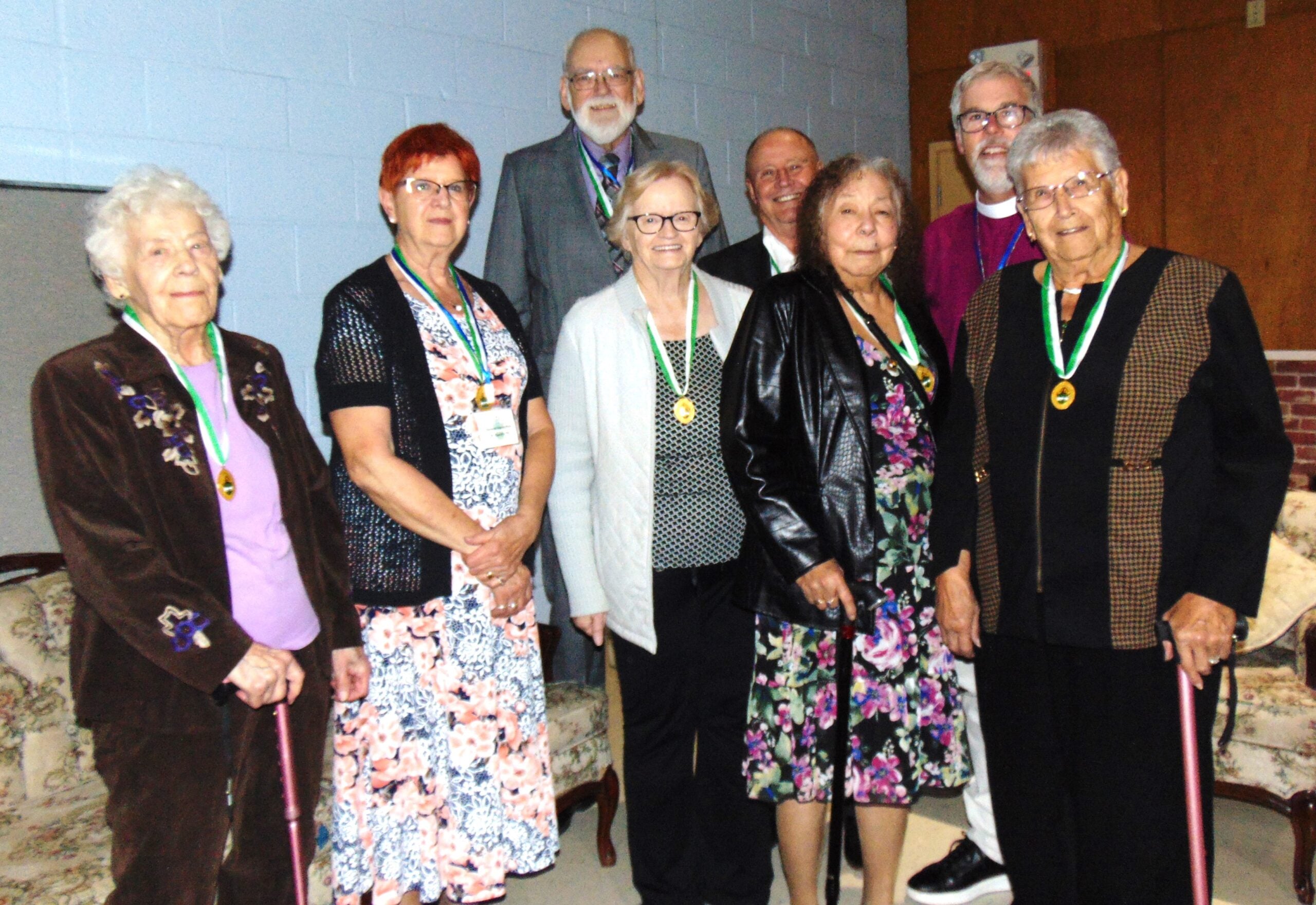
PRINCE ALBERT — The Diocesan Synod held on Oct. 3 and 4 commenced with the Opening Eucharist, including the Bishop’s Charge and the installation of new members into the Order of Saskatchewan. The readings were Isaiah 41:1-13, Psalm 90, Acts 6:2-7, and the Gospel according to Matthew 28:16-20.
Bishop Rick Reed opened his charge by reminding us of why we are here. He shared his faith journey to prove to us that God can, will and does build His Church. He spoke of how, for nearly 30 years, he resisted the Lord until one night his friend was preaching about the truth and merits of knowing Christ our Lord.
From that evening on he knew Jesus was the Son of God, and that He had a plan for his life. And so, he set out to know God and to seek to discern what the plan for his life might be. The Lord told him to remember his passion and dependence on Him, His love for the saints and that He will build His church, and the gates of hell will not prevail against it. In his charge, he calls us all to do this very thing.
Remember who we are. And we who offer ourselves to Him and to His service, saying: And here we offer and present unto thee, O Lord, ourselves, our souls and bodies to be a reasonable, holy, and living sacrifice unto thee.
Reed spoke about the current state of the diocese by observing that every issue we face has reared its head in one way or another in every diocese and congregation for 2,000 years. There are no surprises here.
First, our congregations are in decline, which is not new, as we have been experiencing it for decades. A sense of despair about our decline has been eating away for decades, even in times when smaller congregations would gather 50 or more on a Sunday.
There are many reasons, but there is now a loss of confidence in many, and a growing hopelessness, and it is widespread. The refrain is the same: we need more people, we need young families and children, we need the wayward to return, we feel neglected and, bishop, what are you and we going to do?
We have worked very hard together across the diocese. And yet, in so many places our clergy are spread thin, and the demands of ministry are overwhelming for clergy and lay alike. The truth is we are tired and for many there is a sense of despair, not simply about the state of the church, but about the condition of our world, and ours and of the lives of those we love.
The answer is simple and at the heart of who we are as Christians, “On Christ the Solid Rock I Stand.” This is where our hope is found, not in our gifts and talents, or liturgical innovation, new type of music, some prophetic word, or new program. Our hope is built on the blood of our Lord Jesus Christ. “I say to you this evening, the Lord has seen your toil, he has heard your prayers, and he knows your every need. And he is with us in this time and his call upon us remains.”
What is the answer to the question, Bishop, what are we going to do? It is the same for every Christian and congregation: be who you are as Anglican Christians. Worship together, pray together, bear one another’s burdens, fellowship together, praise the Lord and be thankful together and be present in our communities as ambassadors of Christ Himself.
We need vision, and there are good works that the Lord has prepared for us in advance to walk in, but this task is not a burden He has placed on us. It should be a joy.
Financial hardships also lead to despair. Ministry, apportionment and insurance are our major costs. As a diocese of the Council of the North, our stipends are the lowest in the Anglican Church of Canada. Bishop Rick and the diocesan accountant are looking at other options for insurance coverage. Regarding apportionment, the executive committee has approved a halt on our national church apportionment, and this will be used to reduce parish apportionment in 2025 fairly.
The costs of Indigenous Ministry are running a massive annual deficit, and because of this, we cannot at this time afford to pay a new diocese Indigenous bishop.
Another issue is divisions in our church. Divisions not only threaten to pull congregations apart, but they can be a threat to the diocese itself. Our togetherness in the Gospel (Mamawe), which is so important is at threat. There is only one Diocese of Saskatchewan, and the future of the diocese depends on us walking together. The twinning of parishes in the diocese, Indigenous with non-Indigenous, will be revived so we can pray for one another, worship with one another and fellowship with one another.
With the retirement of Bishop Adam Halkett in September, that means there is now only one bishop to ordain and confirm. This creates opportunities for Reed to get to know the parishes and communities in the north in a new way, which he looks forward to.
His closing thoughts: We must recover the missionary roots that founded the Diocese of Saskatchewan in our day. And we must remember that the future of the church when we have prayerfully done what we believe we are called to do in our day, is not ultimately in our hand, but it is in the hand of the Lord Himself.
He is our Head, and this is His Church. The task of fulfilling the great commission is ours in the Lord, but the fruit come that is born is His. And so, for us the real task is to keep the Lord Jesus Christ and the Gospel at the centre. And we must remember that unless the Lord builds the house, those who build it labour in vain.
In keeping with the bishop’s message, recognition was given to Elaine Thorne, Opal Harris, Ethel MacFie, Grant Laird, John and Noreen Hareuther, Priscilla Joseph, and Lawrence Joseph (posthumously) by bestowing on them the Order of Saskatchewan, recognizing them as exemplary witnesses to Jesus Christ and who have offered exceptional service to the Diocese of Saskatchewan.