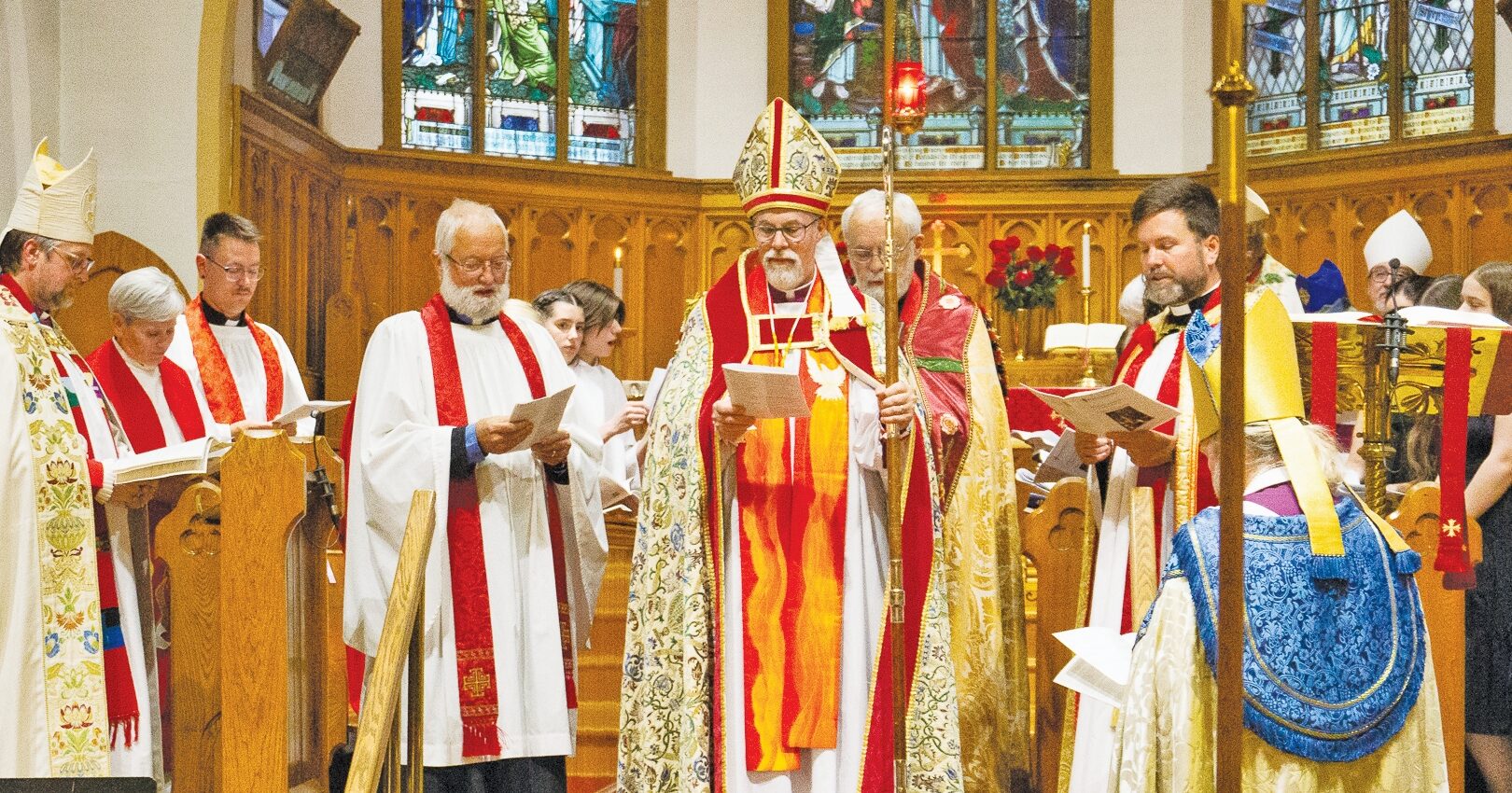
PRINCE ALBERT — In its report about finding a new bishop, the search committee stated that many priests and bishops in the Anglican Church of Canada and the Anglican Communion were approached to consider letting their name stand for election as the 13th bishop in the Diocese of Saskatchewan.
I spoke with now-Bishop Rick Reed as to why he accepted the nomination. He said he has always been willing to go where God leads him. He had been asked by people in his parish and beyond if he would accept the nomination and his wife was also supportive of the decision to run.
He is also concerned about the future of the diocese with its rich spiritual heritage that should be protected. The diocese has safeguarded traditional Anglican faith and because of this has consistently drawn clergy committed to seeing faithful and growing Anglican churches.
The diocese has a large number of Cree Anglicans. This unity must also be strengthened and protected.
“To serve as bishop is not simply a job but a calling that comes with great responsibility to God and his Church,” he said.
God’s plan
From the very beginning, God had a plan for Rick even though he kept ignoring the signs until at the age of 23, while visiting with his friends, he accepted what he subconsciously knew all along.
“It was like time stood still, and I felt this presence, and I knew, it was the Lord,” Reed said.
Next on God’s agenda for Rick was joining short-term missions.
He enrolled in Discipleship Training School and spent the next three years on missionary work in places like Calcutta, India.
“I learned a lot. I saw what is possible when Christians are willing to say, ‘Here I am send me,’ and step out of their comfort zones into unknown territory with the Lord,” said the new bishop.
Becoming Anglican
Reed’s interest in the Anglican way started when he and his wife-to-be, were looking for insight into the vows they would say at their wedding. He remembered his uncle giving him the Episcopal Prayer Book and found the liturgy for the Solemnization of Matrimony.
In Whitefish, Montana, about a year later, he attended a Maundy Thursday service and the Easter Service.
He felt it was the beginning of God drawing them into the Anglican church.
This is when he moved to B.C. and attended Regent College. From 2001 to 2004 the family lived in B.C. and in 2004 moved to Dauphin, Man., where retired Bishop Malcolm Harding encouraged him to speak to Bishop Jim Njegovan.
That bishop accepted him as a postulant and that is where he started his ministry, as a priest in the Diocese of Brandon.
A bishop’s role
To be the bishop is a daunting task and for now the new bishop wants to get to know the people and churches in the diocese.
“The most important role of the bishop is to serve, shepherd, lead and protect the clergy and the people of the diocese,” Reed said. “The goal of this ministry is that the whole church be built up, growing in their knowledge and love of God together through Anglican worship and discipleship, and growing in their love for one another in fellowship and prayer that they may be biblically faithful evangelizing communities.”
He realizes now more and more every day that there is no way to know the job until you do it.
The hardest part of his ministry will be “juggling the administration versus the pastoral. Not allowing the institutional side to take over the pastoral, it is like jumping into the pool in the deep end with only a few lessons,” he continued.
A new leader’s priorities
In answer to what his priorities are in the rural and urban parishes, the bishop said, “There is a dark cloud, like Pig Pen in the Peanuts’ comic, so much doom and gloom, a cloud that follows people around they lose confidence and hope,” Reed said.
“There are a lot of reasons for hope. Try to make the condition such that the parishes gain hope and joy and confidence as who we are as Anglicans and Christians.”
Also, “Working with young people and youth and families is one of the most important things in the diocese.”
He would like to have a conversation about the vision of the five points, but especially we need to focus on and equip lay leaders in our churches. Also, discipleship, we need to put the word into action.
National church involvement
As a bishop there will be more involvement with the national church, so how does he feel about that?
“Their agendas cannot be ignored. We have to focus on the Diocese of Saskatchewan. The bishops have kept us from going off the rails,” Bishop Reed said.
“The most important thing in the Anglican Church of Canada is the growth of our parishes. Church shouldn’t be in survival mode. If we do things we ought to and we are not successful at least we tried. If you believe in something keep trying.”
He has been an active member of many church congregations and organizations and one thing he has learned is regardless of what denomination or church-related organization, the church has a real penchant for committees.
He admits some are necessary for parishes and the diocese to function but if you find the gifted and talented people with a passion for whatever it is you can trust them to get the job done.
Life before the priesthood
Before his appointment in the Diocese of Brandon, Reed worked as an office administrator, assistant teacher, security and maintenance at Regent College and volunteered at St. John’s Shaughnessy leading their weekly “Central Focus” discipleship program.
He was also involved with a local church plant, which began as a Sunday afternoon lunch and worship gathering targeting the community of Kerrisdale. At the time, it was considered the “most unchurched” neighbourhood in Canada. This congregation grew from a handful of people to 20 adults and many kids.
On Sept. 6, Rick Reed was consecrated as the 13th Bishop of the Diocese of Saskatchewan. He and his wife Julie-Anne are happy and eager to begin their ministry of hope, joy and renewed relationships with everyone in the diocese.