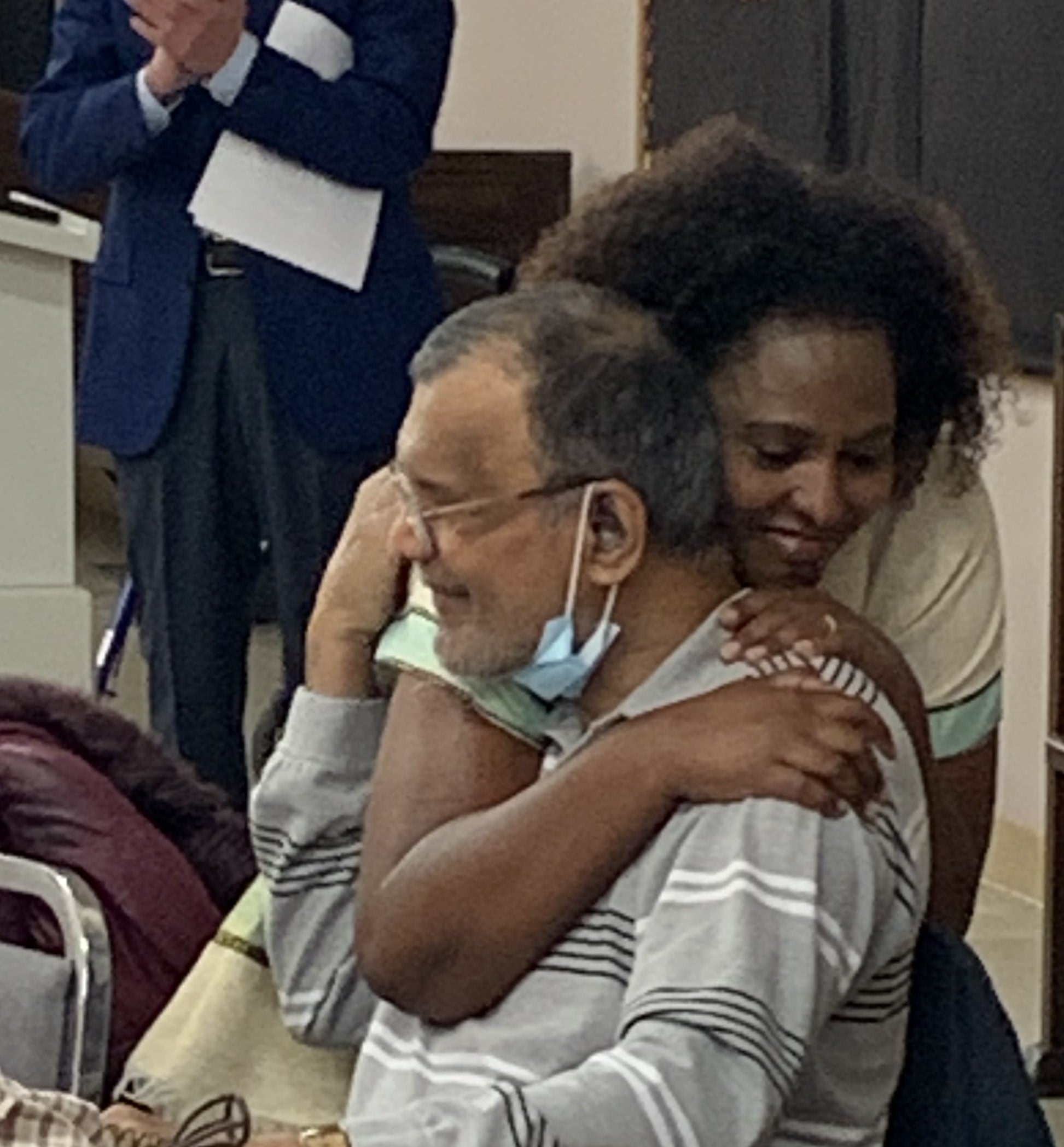
REGINA — More than 30 years ago, Rev. Gary Paterson asked Ralph Paragg if he would take on refugee work “on a temporary basis.” On Oct. 5 of this year, Paragg was honoured following his retirement from that work.
Bishop Helen Kennedy said, “Tonight we celebrate an extraordinary individual who has had a profound effect on the lives of countless refugees.” She described his “tireless efforts” and said, “His dedication has transformed lives.” Kennedy commended Paragg’s “unwavering spirit” and presented him with a diocesan plaque.
About half of the approximately 80 people who filled Immanuel parish hall were refugees or family members of refugees who Paragg had assisted in coming to Canada, and specifically Regina. Several took the opportunity to thank Paragg.
Mimi Mousa spoke on behalf of her family, giving “the biggest thank you” to Paragg and saying, “We don’t know what we have done to deserve a person like you.” Mimi, now a teenager, had arrived in Regina as a tiny baby, with her parents Saafa and Marleen Mousa, who were sponsored by the Diocese of Qu’Appelle. Since arriving from Iraq, the family has grown to include three daughters and has become active first in St. James, and now in Immanuel Anglican Church.
A woman said, “I thank Almighty God for creating the person of Ralph!” She described how she had met him at a training session with the Regina Open Door Society, where Paragg had been a board member for many years. He mentioned to her that he had, through the diocese, two sponsorship spots not yet filled by potential refugees. She had two cousins who were trying to leave Israel, and gave him their names. “Our family is enriched by what you have done.”
She thanked him for the many hours he devoted to each individual and his meticulous work on official papers, and spoke of the children who have been born in Canada and the opportunities they have because Paragg helped their parents come as refugees.
Dessie Gebreyesus, a former refugee from Ethiopia, presented a crystal plaque to Paragg and Immanuel Church. He thanked both for changing lives, and for giving “more than just a safe place to live — a second chance.” Another former refugee, Naser Osman from Eritrea, gave Paragg a picture of Jesus, made on an animal hide. Paragg noted that Osman is a regular volunteer with his crew at the parish Peach Festival fundraiser.
Archdeacon Cheryl Toth, who had been Paragg’s parish priest some years ago, thanked Paragg for “being an inspiration and a challenge to us.” Archdeacon Catherine Harper also spoke on behalf of the diocese.
After people had given their thanks, Paragg came to the microphone. He joked about the “temporary basis” and described how the diocesan involvement with refugees had changed over the years.
It started slowly, with only a few people each year, and gradually increased. At first, All Saints Church, Regina, developed a refugee contingency fund, and held fund-raising suppers and a couple of pub nights. The parish mission and outreach committee gave financial help to the Lutheran Church to sponsor a refugee family, and provided financial assistance to a refugee student.
The diocese began sponsoring a few years after Bishop Michael Peers became Primate in 1986. Initially it was quite informal, just a handshake arrangement. In about 2019, the Immigration department began to do audits, and the diocese realized that documentation needed to be more official. The diocese acts as a sort of banker for families or groups who raise the money required before refugees are approved to come to Canada.
Paragg helped with completing many forms, and navigating the government systems for the refugees and their supporters.
Paragg said that from 2014 to September 2024, the diocese assisted more than 600 refugees. “I’ve lost track of the totals before that,” he admitted. In 2023, a record of 95 people were sponsored, and a record 75 refugees arrived. Paragg explained that there is often a delay of a year or more between sponsorship and arrival. So far in 2024, there had been 51 arrivals.
He told the audience that over the years, most of the refugees have come from East Africa, especially Eritrea, and to a lesser extent Ethiopia, Somalia, Burundi, Rwanda, and South Sudan. In addition to East Africa, refugees have been sponsored from Iraq, Syria, Lebanon, Afghanistan, Pakistan and Myanmar.
Paragg said that he has made many strong friendships with refugees and their families, noting, “We get invited to many weddings” and other celebrations. The event to honour Paragg was also a celebration — a potluck dinner that included delicious food from many different cultures.