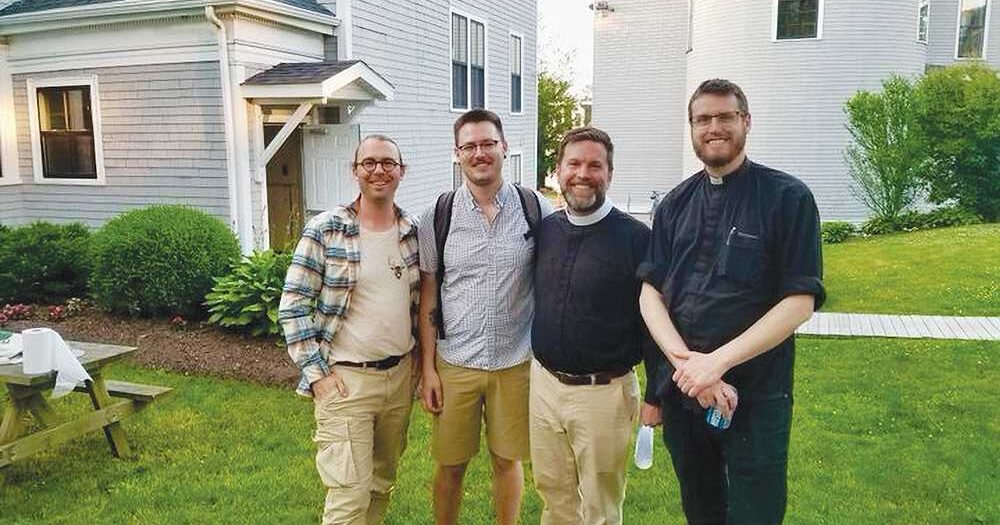
PRINCE ALBERT — This last summer, four clergy from the Diocese of Saskatchewan went to Halifax, Nova Scotia, to attend the 33rd annual Atlantic Theological Conference at St. George’s Round Church.
These were the Reverends Jordan Draper, Teddy Williams, Brody Albers and David Butorac. The conference meets every year in the summer for one week, in different Maritime cities.
This year saw participants from the Maritimes, Georgia, Wisconsin, Scotland, and of course the “Saskatchewan 4.”
Many attend frequently, thus the event is a family reunion. Each year the conference takes on a contemporary or doctrinal topic.
This year the topic was on “Incarnation” and for one-week participants heard papers on Christ’s incarnation.
In fact, the aim of the conference is to help churchmen and women bring these topics into their everyday lives and conversations.
With this in mind, the conference had papers by clergy, academics and lay people. Indeed, many of the speakers come from fields outside theology, like history or literature. By this diverse array of speakers, a bridge is built
between what is complex to the wider church. We hear many perspectives on a topic. This enables participants to return to their home church with familiarity on a subject.
One fruit was to appreciate how the incarnation is a source of unity for Anglicans. Celebrating the incarnation is a quality of Anglican worship.
We choose to stay loyal to Jesus as He is present in our church. Furthermore, we appreciate how Jesus is present in other branches of the church.
The guest speaker, John Behr, Aberdeen University, shed light on the topic with a book study on St Athanasius’ Incarnation.
Most of all, this conference frames itself within worship. Each day begins with Holy Communion, and the day ends with evening prayer. In effect, the meals, the paper, the discussion, the friendships, and the papers are an extension of worship.
Its purpose is to glorify God. Through prayer and discussion, the conference even learns ways to handle controversy, without inflaming the passions. Instead, we learn how to listen.
Perhaps this emphasis on prayer and listening is what draws in the number of young people, including families and half a dozen infants. In this way, the conference is a gem of the Anglican Church of Canada.
On a last note, the conference is an example of how our church values continuing education as part of discipleship. This opportunity can happen because our church encourages clergy to take a weeklong study leave every year.
There is also the possibility to seek funding the church pension office. The four clergy certainly appreciate the chance to study together.