REGINA — If sacred art and sacred space are where the transcendent becomes immanent — manifest in the material world — and people deliberately put themselves in the presence of God, then sharing your favourite works of sacred art and sacred spaces becomes an intensely personal and intimate act of trust.
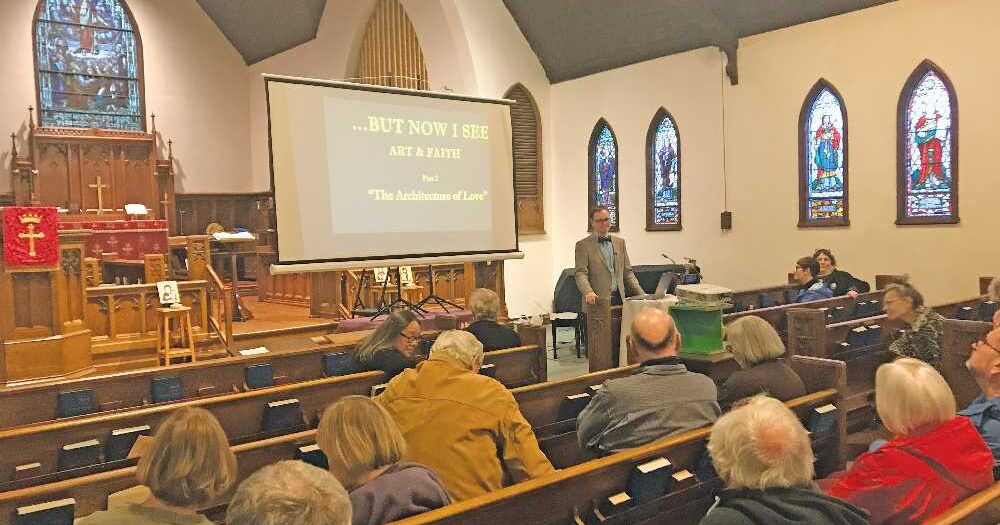
Timothy Long, head curator of the MacKenzie Art Gallery and adjunct professor at the University of Regina, embraced that trust when he led two evening lectures at St. Mary the Virgin parish in Regina. The lectures, “But Now I See… Faith and Art, A Curator’s Journey,” were part of St. Mary’s contribution to the Cathedral Village Arts Festival 2024.
This is the second year that Canon Claude Schroeder has hosted events at St. Mary, focusing on faith and art as part of the festival.
The first evening was devoted to works of art, and entitled “The Art of Compassion.” It began with the story of a drawing of St. Joseph by Renaissance master Andrea del Sarto. Long noted how St. Joseph was given stewardship — the responsibility for care — of Jesus and St. Mary; he was not Jesus’ father, but he had all the responsibility of a father.
The willingness to shoulder such responsibility is a mark of great compassion, and, according to Long, is echoed in the role of artistic curators, who do not create or own the works of art for which they care.
The lecture continued with a tour of works of art that nurtured Long’s own values: compassion, individual involvement in care for the poor and needy, the Christian response to violence and victims, an understanding of the human tendency to scapegoat others in response to our own pain, and, ultimately, an “ethics of viewing” that we should bring to each artwork we experience.
Photographic works by Saskatchewan-born artist Sandra Semchuk, made in collaboration with her Cree husband, James Nicholas, examined the importance of bearing witness to the traumatic and shameful realities of historic colonialism.
Long called on the audience to travel with Semchuk and Nicholas along the “path of reconciliation through honest listening and love.”
The second evening, “The Architecture of Love,” was spent virtually visiting Long’s favourite churches, each reflecting different architectural and social models. Long also discussed how the architecture of each church reflected prevalent views on humanity’s relationship with God at the time of its construction.
The evening itself moved through time, starting with Santa Constanza, a fourth century church in Rome dedicated to the daughter of the Emperor Constantine, and originally believed to have been built by him.
Just as Constantine straddled the Roman and Byzantine eras, so too the church shows elements of each society. It is largely Roman-classical in style, and in its solidity and immenseness, reflects the importance and “eternal” nature of the state and of the church — and of Constantine’s love for his daughter. But it also contains early Byzantine-style mosaics and frescoes embellished with gold, which illumine the space, as the light and love of God illumines the heavens and our lives.
The tour continued with a Gothic cathedral, whose pointed arches and slender, heaven-pointing spires remind us to focus on the spirit and on heaven above. As opposed to the rounded arches of the Roman style, Gothic pointed arches were better able to bear weight, allowing the churches to grow significantly higher.
These pointed arches were not only used for practical reasons; they were symbolically significant in that they pointed towards heaven. The soaring towers and spires permitted more light into buildings, and thus, was the start of the magnificent stained-glass masterpieces often associated with churches.
In addition to being beautiful and done in jewel tones, recalling Revelation 21:16-21, the windows were designed to be teaching tools about the Christian story for a largely illiterate society. Everything about Gothic cathedrals is transportive and ethereal, lifting the gaze of the viewer to God above, and reminding us how small we are in comparison to the magnificence of the Trinity.
In flamboyant contrast, a baroque style church was overwhelmingly elaborate, with chubby cherubs and elaborate carvings, and dramatic and theatrical effects, such as trompe-l’œil and quadrature — the use of painted ceilings that gave the illusion that one was looking up directly at the sky.
Baroque church architecture first appeared in the late 16th and early 17th century as a means to counter the austere and academic style of the Protestant Reformation. It aimed to inspire surprise, emotion and awe. Despite their lush ornamentation, Baroque churches emphasized devout worship, while demonstrating the church’s power and status.
The second last church on the tour was Le Corbusier’s modern masterpiece, Notre Dame du Haut, a chapel in Ronchamp, France.