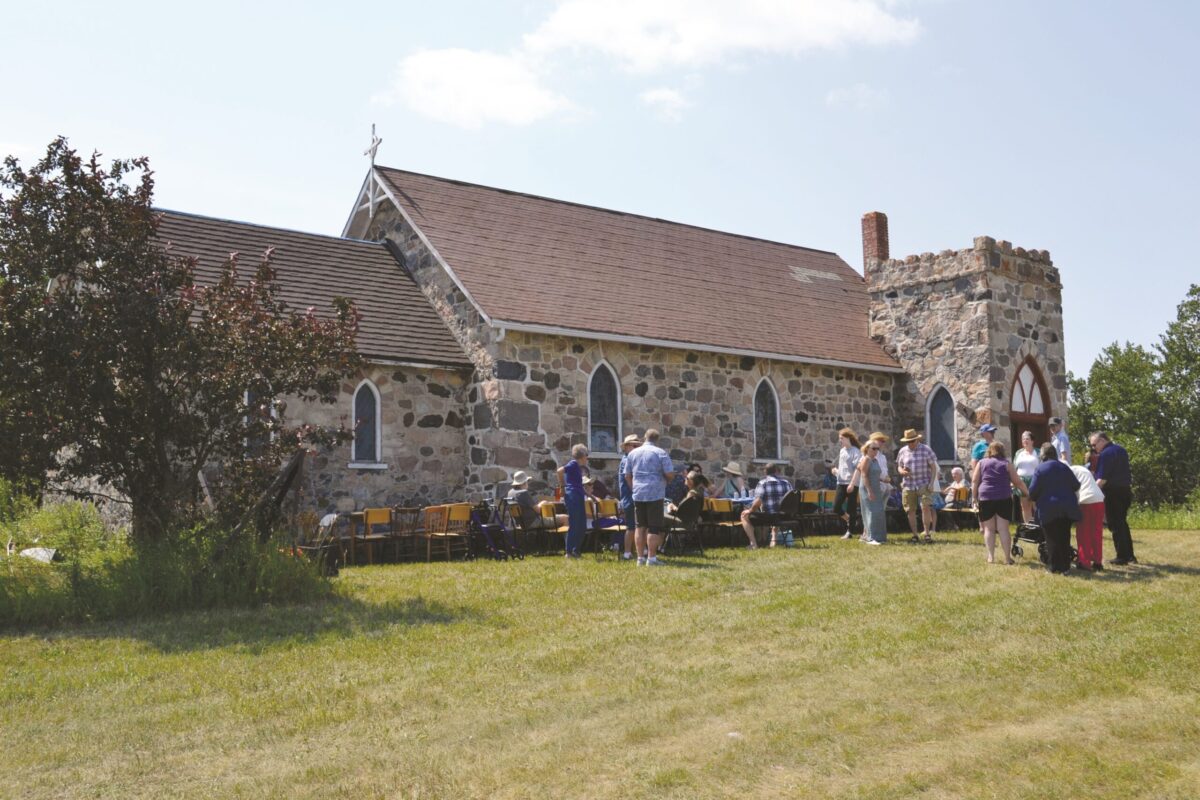
VERNON (Qu’A) — The congregation of St. Thomas’ Anglican Church, along with grandchildren, great-grandchildren, great-great-grandchildren and even great-great-great-grandchildren of the original parishioners, as well as friends from nearby churches, gathered on the August long weekend to celebrate the 125th anniversary of the consecration of the church building.
The celebration began on Saturday with a noon barbecue provided by members of the congregation, followed by various tours and talks.
One of the church wardens, Allison Fizzard, provided background information about the interior of the church, including the stained glass windows, and some of the furnishings such as the oak altar carved by Valentine Eliot, a professional woman wood-carver in England in the late 19th century.
A son and daughter of Eliot emigrated to Vernon District and were among the earliest parishioners of the church. Fizzard also talked about the reredos painting, a creation of Alice M. Erskine, a professional artist and decorator of churches in England in the 1890s.
The other warden, Bruce Farrer, told a variety of anecdotes about each of the ministers who served this congregation, beginning in 1888, 11 years before the church was built, when services were held at Edgeley Farm or Vernon Bluff Farm. At the time of the First World War the congregation was so large and came from such a widespread area that the parish even had a resident minister.
One of the vestry members, Brian Herman, conducted a cemetery walk, giving information not generally known about some of the 106 people buried in the cemetery. As well, the 70 people in attendance were directed to the location of 15 evergreens, each commemorating a baptism that has occurred at Vernon Church since its 100th anniversary in 1999.
The children, some of whom are now adults, had each prepared a laminated sheet stating their names, dates of birth and baptism and the names of their parents and godparents. Each of these sheets was placed at the appropriate tree.
The eight Platinum Jubilee fruit trees were each identified in a similar way, stating the names of the dignitary and member of the congregation who had planted each tree to celebrate Queen Elizabeth’s 70 years as Canada’s monarch.
The group then walked or drove to the site of William Cooper’s former home, 200 metres west of the church, where services were held for four years prior to the building of the church.
On their way to the supper at Edgeley Community Centre, some visitors stopped at the site of the former Edgeley Farm where Anglican services were first conducted beginning in 1888.
This was near where, in 1885, the Fraser and Fessant families fed members of Chief Piapot’s band homemade bread spread with bacon grease, and apple pie with side pork to Chief Piapot and two sub chiefs.
Their descendants, the Olson family of Edgeley, brought homemade bread spread with bacon grease to the Edgeley Hall as a snack before everyone enjoyed a considerably greater variety of food provided by Richard Sherle, a local caterer, who by coincidence now lives on the former Edgeley Farm.
A typed page of Vernon Church trivia questions was placed on each table for the supper. The Wass/Stinson/Kessel table correctly answered the most questions.
On display at the Edgeley Hall were paintings donated by local artists from the Vernon District, historical documents including the W.A. Minutes Book from 1900, and a family tree showing how almost every family from the Vernon congregation of more than 350 people over the last 125 years, were related to each other through marriage.
Souvenir coffee mugs, history booklets, jigsaw puzzles and CDs by the Christian musical group “Common Cup” were available. Scott Macdonald, a long-time member of Common Cup who is a descendant of four original Vernon families, attended the supper.
The history booklet contains many interesting details, such as: in 1900 the congregation averaged about 50, but was sometimes much larger. For instance, on April 22 of that year, “… Bishop Grisdale preached to a congregation of 105 (with the collection amounting to $5.15).”
Elsewhere in the booklet, is the information that an early organist at St. Thomas, Miss Phyllis Eliot, lived so far from the church that the congregation bought her a pony to ride to church.
Women, in particular members of the WA (Women’s Auxiliary), played a prominent role in the church and its finances. Records show that in many years, the WA contributed more than half of the money for the minister’s stipend, expenses, diocesan assessment and insurance.
The women organized sales of handwork, dances, teas, picnics, dinners and more as fundraising events. The history booklet records “… the unmarried members sponsored a ‘Spinsters’ Dance’ … in February 1903. The profits were so great ($65) they decided to build a new church barn.”
In the late 1990s, St. Thomas was part of the Parish of Indian Head. The parish council strongly advocated closing St. Thomas and nearby Holy Trinity, McLean. To prevent that, the two congregations petitioned the bishop to form their own separate parish, which was granted in 2000. (Holy Trinity has since been disestablished, and Indian Head parish.)
Through the history of the church, services have been held more or less frequently — from weekly to every two weeks; through all the year or only in summer and fall. Currently, services are held from Easter Sunday until late fall, and on Christmas Eve. Retired clergy and lay people conduct the services.
Although St. Thomas has a small congregation, it is an active church. In recent years they have sponsored three refugees from Iran and Syria, and participated in the LOOP program, which gives boxes of food every second week to people in the area who have financial challenges.
Sunday morning began with a musical prelude by a recorder group and a service of Thanksgiving conducted by Bishop Helen Kennedy, Bishop of Qu’Appelle. After the service the congregation shared a large assortment of food at a potluck dinner.
A time capsule, containing coins, a variety of documents, and letters, to be opened by the congregation of 2049 was sealed on Sept. 28, the actual date of the consecration in 1899.